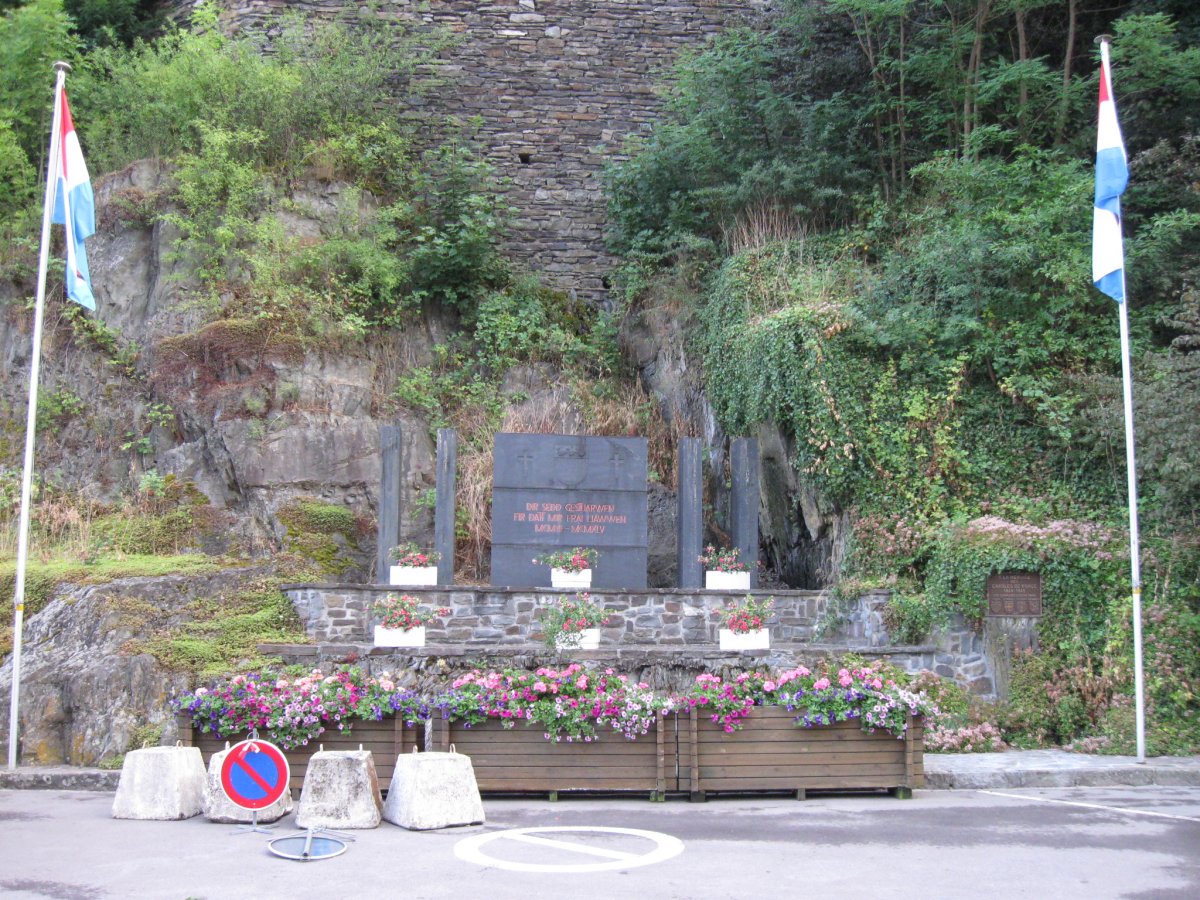
Around 7:15 AM, while the rest of my family was getting ready for breakfast, I made a brief walking tour of Clervaux. I wish I had gotten up an hour earlier, because there is much to see there, and I didn't permit myself anywhere enough time. The first thing I discovered not far from the hotel was a memorial to Clervaux citizens of WW II.
The plaque says "DIR SEDD GESTUARWEN FIR DATT MIR FRAI LIAWWEN 1940 - 1945". My understanding is that this translates roughly to "THEY DIED FOR OUR FREEDOM"
This one monument brings to mind two unrelated facts that I learned about Luxembourg:
(Actually, that's a third thing I learned: there is a native Luxembourgish language. It is impressive to me--an American with more than six years of public school French in my past, and who can't even order a glass of water in a restaurant--to meet all these people who speak English as a third or fourth language, and who are more understandable than friends of mine who have a strong Boston accent. Very impressive.)
Anyhow, after encountering this monument, I hiked up to the big church in town.

When I had at first arrived in Clervaux, I confused this church for the Abbey at Clervaux, which is where the 6th Armored Division and its 212th AFA Bn had their headquarters. I had hoped to visit it, but Daniel had warned me that it was a long, steep walk to get to it. I found the path leading to the Abbey right next to the church and I started hiking it to see how far I would get. But I didn't get far. I told my family that I would meet them for breakfast at 8 AM, and I figured it would be rude to collapse on the steep path with a heart attack when they were hungry. So I grudgingly gave up on the idea of seing the Abbey, and returned to the hotel
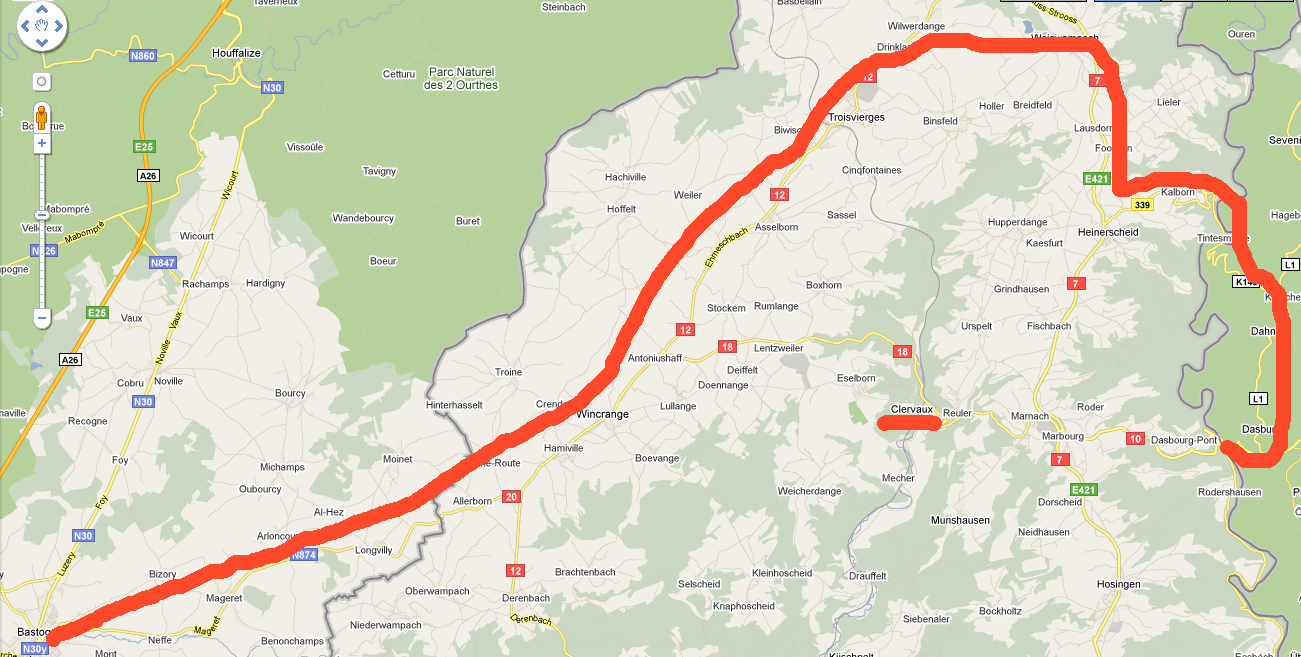
After breakfast, Daniel met us at 9 and we started to plot our day. In our pre-trip e-mail, I had said that I would like to generally follow the 6th Armored Division's path through Luxembourg, and make sure to see the 6th Armored Division memorials at Trois Vierges and Heinerscheid. Daniel proposed a day starting at Bastogne, proceeding across northern Luxembourg, and ending at the Our River where the 25th Engineers famously made the crossing into Germany possible.
Here is a map of the Super Sixth's path, which we hoped to follow:
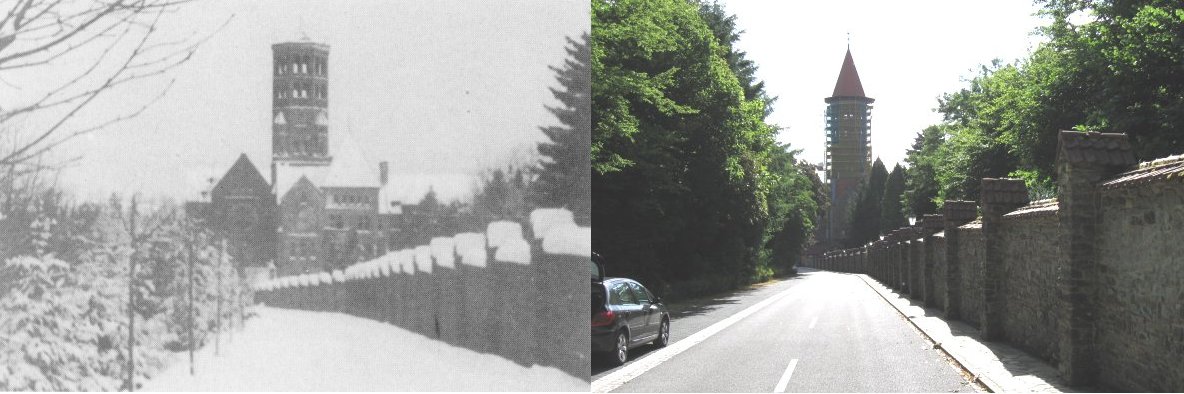
 But first, Daniel suggested, we could drive up to the Abbey. I almost declined, not wanting to overbook our day, but he said that it wouldn't take long, and I am very glad that we took his advice. We jumped in our cars and after a 10 minute ride, as we approached the grounds, I realized that he was taking us to the exact location that a 212th AFA photographer had snapped the photo in 1945 that was used at the top of the "Luxembourg" chapter of the 212th AFA Bn History .
This provided me with my first "then & now" photo opportunity of the day:
Then it was off to Bastogne.
For a student of WW II history, and one who had somehow managed to avoid traveling to Europe all my life, seeing actual road signs with names like Bastogne, St. Vith, and Malmedy was very exciting. I was finally making a pilgrimage to a place that I had read about, seen on TV, and heard about from people who fought there, all of my life.
But I had to keep reminding myself that what Sixers saw of this area was very different from what I was experiencing. We were cruising along good roads, in the middle of summer, in a beautiful countryside dotted with majestic, modern windmills.

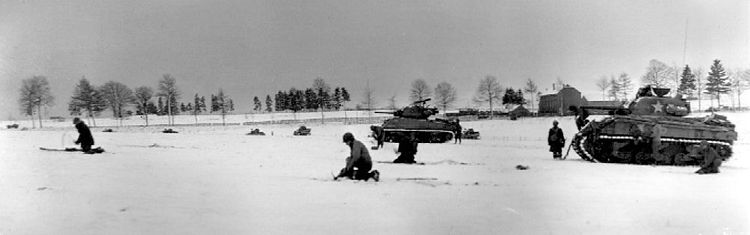
When our fathers and grandfathers traveled these roads, the roads were covered with snow and ice, temperatures were dipping below zero, and the fields were dotted with tanks and infantry.
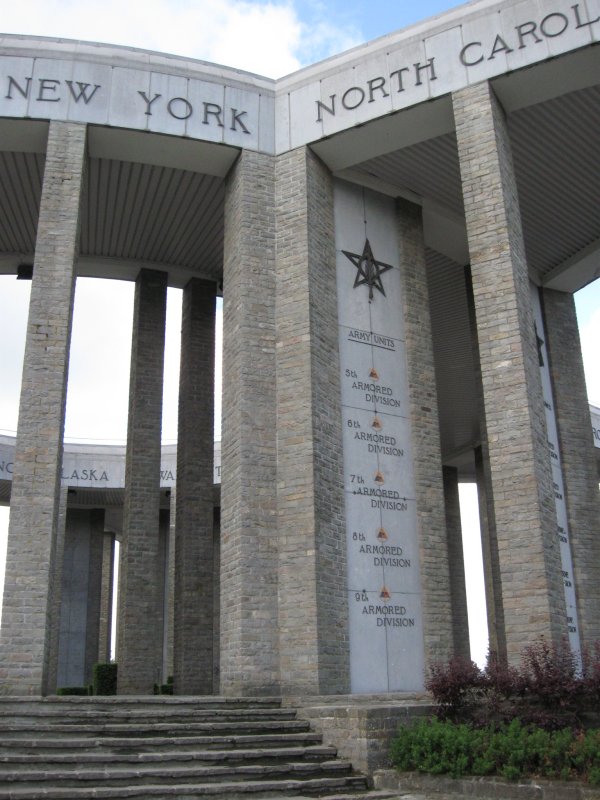
Finally we arrived at the impressive Mardasson Historical Center and Battle of the Bulge memorial outside of Bastogne.
We climbed to the top, which gives a great view of the countryside, with Bastogne visible in the distance.
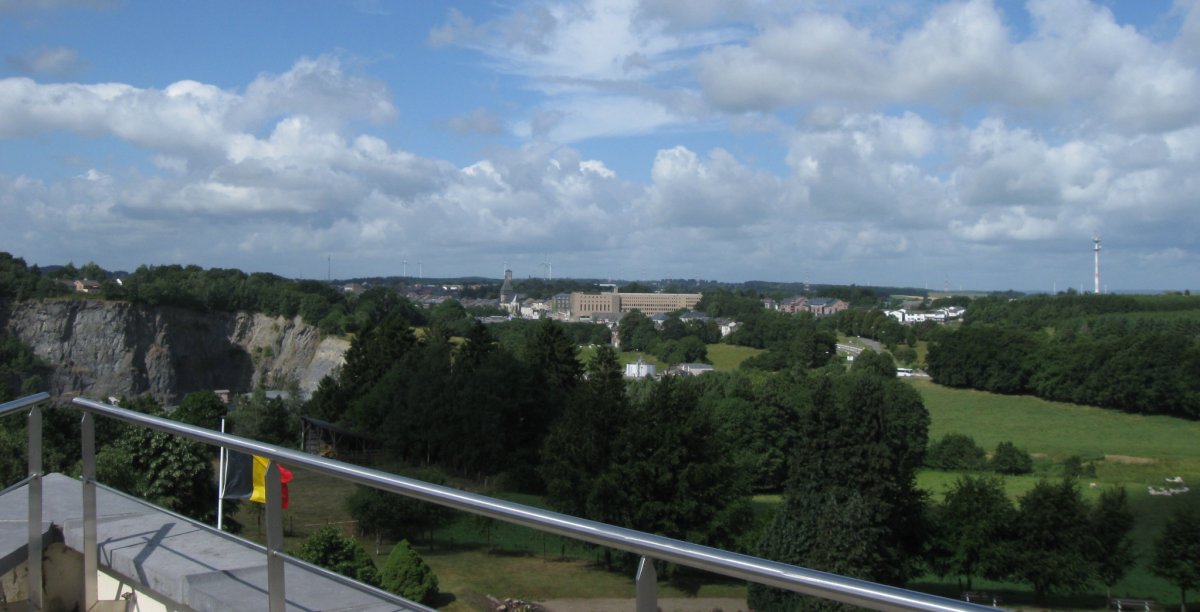
Daniel pointed out the movements of various units from this vantage point, and got me oriented to the whole situation from mid- to late-December.
We spent a little while longer at the memorial, and decided to drive toward the city of Bastogne. Daniel left his car in the parking lot, hopped into our vehicle, and we were off.
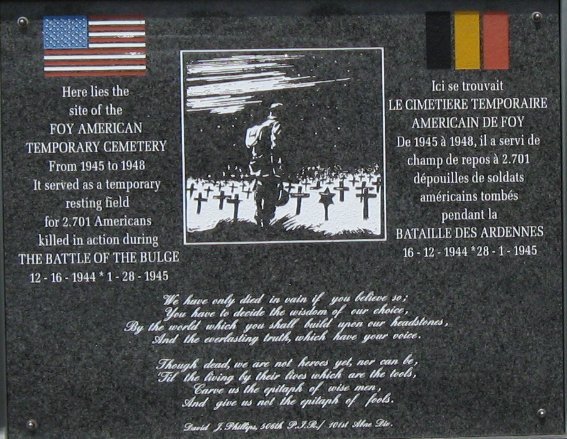
One stop we made was at the site of the temporary cemetry at Foy, where both Americans and Germans were buried, before being moved to the Hamm cemetery.
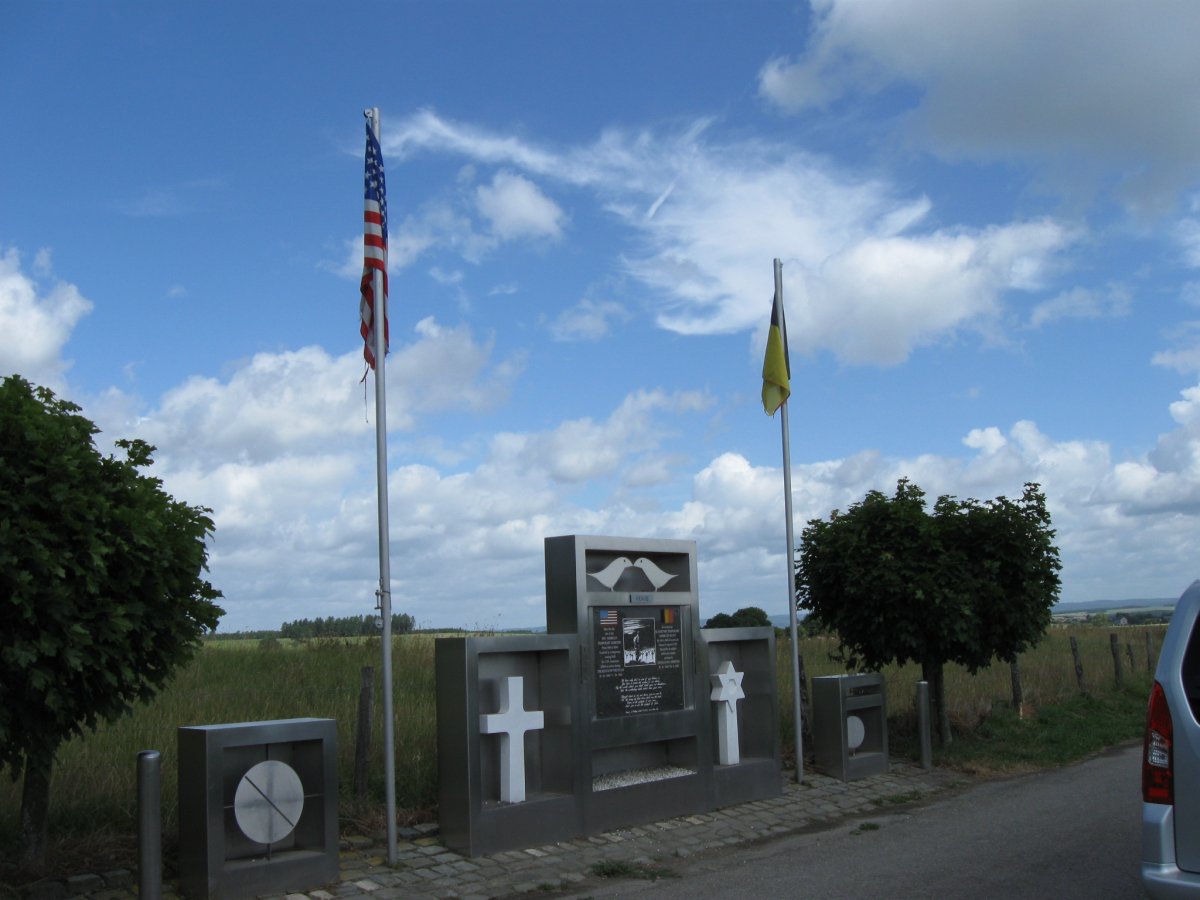
We drove through Bastogne and headed for Wardin, which has signifcance to Sixers for at least two reasons:
January 4 is recognized as one of the toughest days the Super Sixth experienced in the ETO, and Wardin was at the center of the tough fighting. You can read about this phase of Division history at https://www.super6th.org/record/ardennes_009_pages_156_157_04_jan_45.gif.
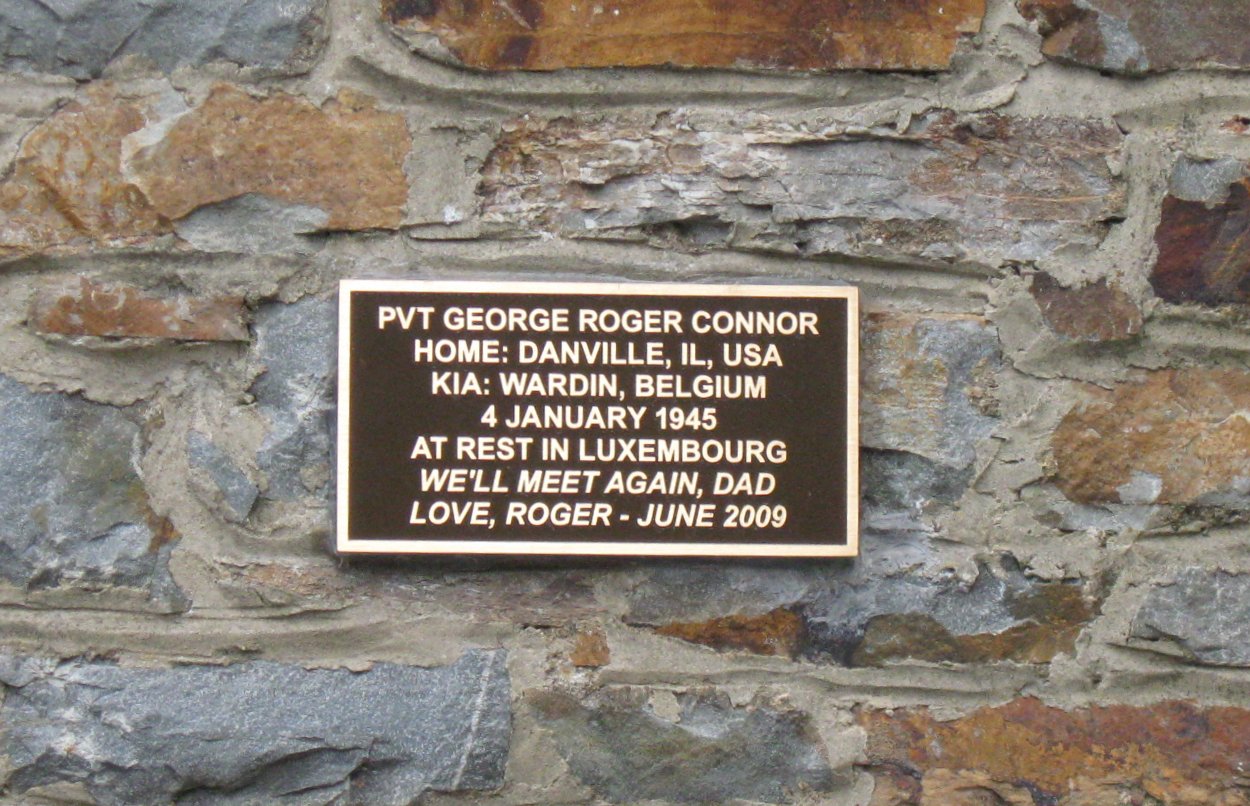
Members of the Sixer e-mail list may remember Roger's posts about the dedication of a plaque memorializing his father. Daniel took us to the location of the plaque, and we stopped and paid our respects.
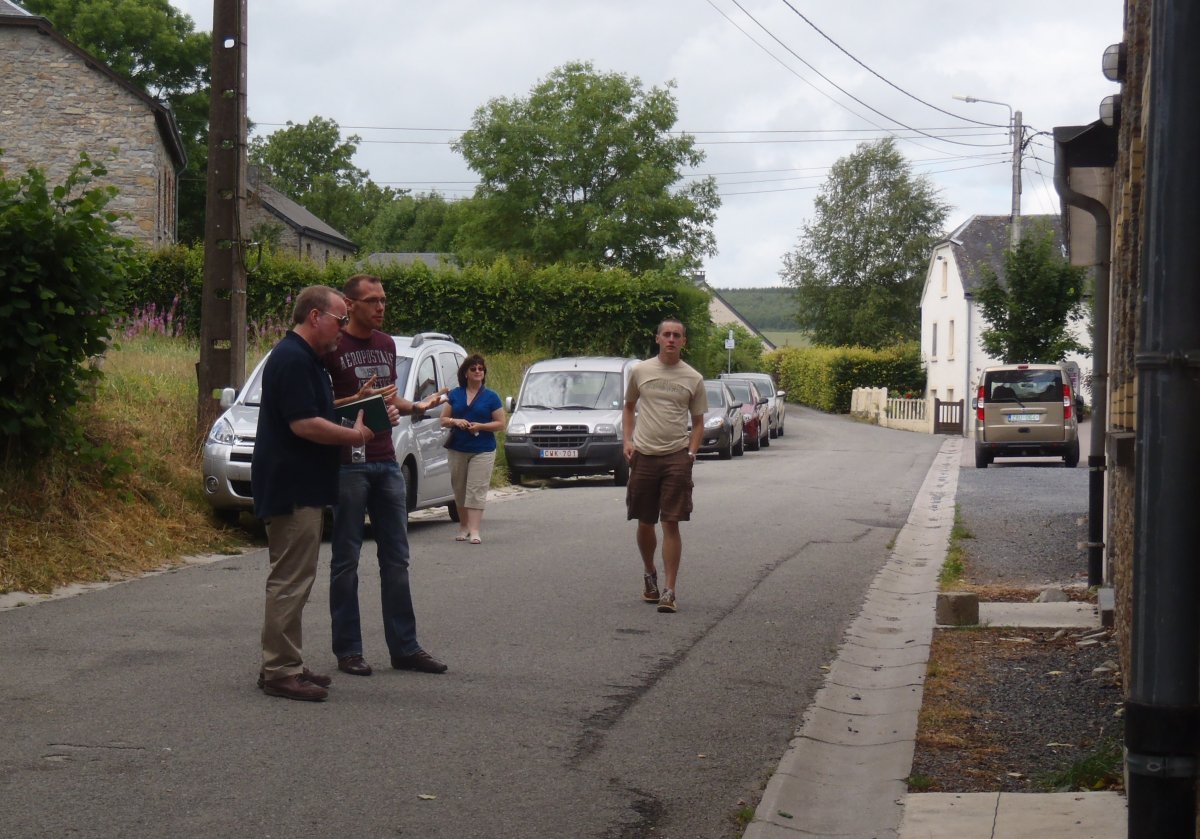
At this point, it was already lunch time, so we drove back to the Bastogne memorial to pick up Daniel's car, and we drove to Bastogne to find a good place for lunch. I won't take up space here with photos of Bastogne center and the memorials there. They are often photographed, and don't have a direct connection to the 6th Armored Division. Suffice it to say we had a good lunch, followed by good ice cream.
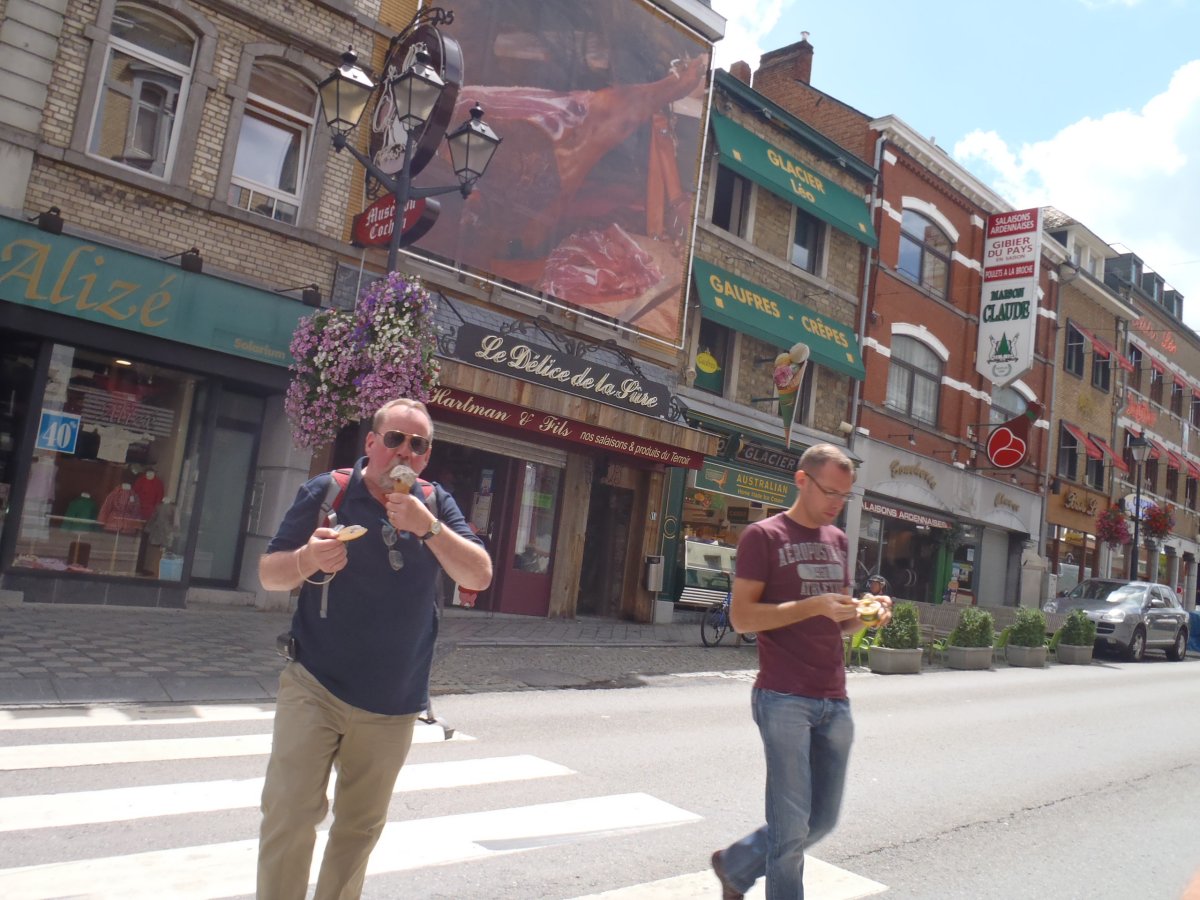
Okay, one Bastogne photo. Danuel reconnoitered a likely target for a swift ice cream liberation operation. We moved in, accomplished our mission with utmost efficiency, and nobody got hurt:
At this point I was starting to get concerned about time: we had already finished lunch, and we hadn't even crossed over into Luxembourg yet. It was time to head out.
One of our stops on our way to the Luxembourg border was Mageret. This is a site of one of several Belgian informational kiosks.
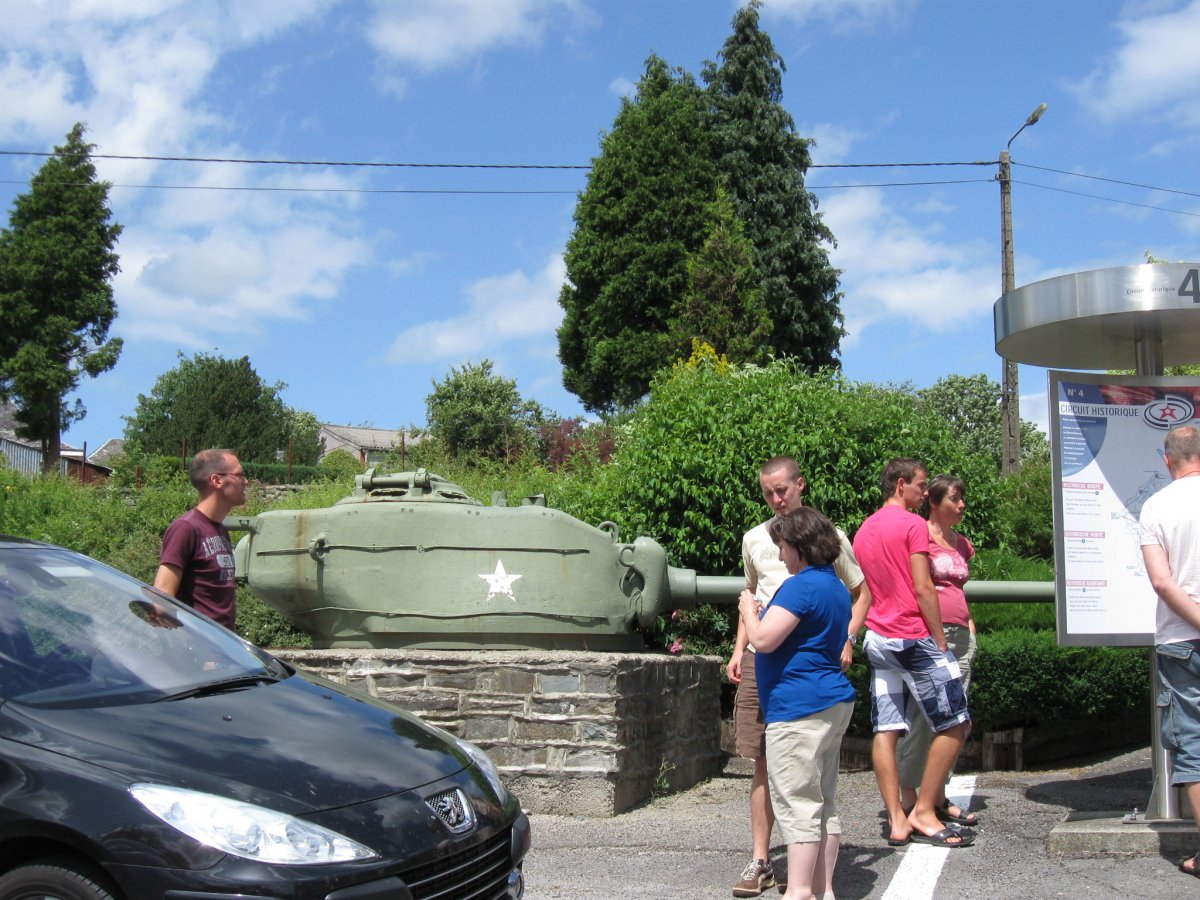
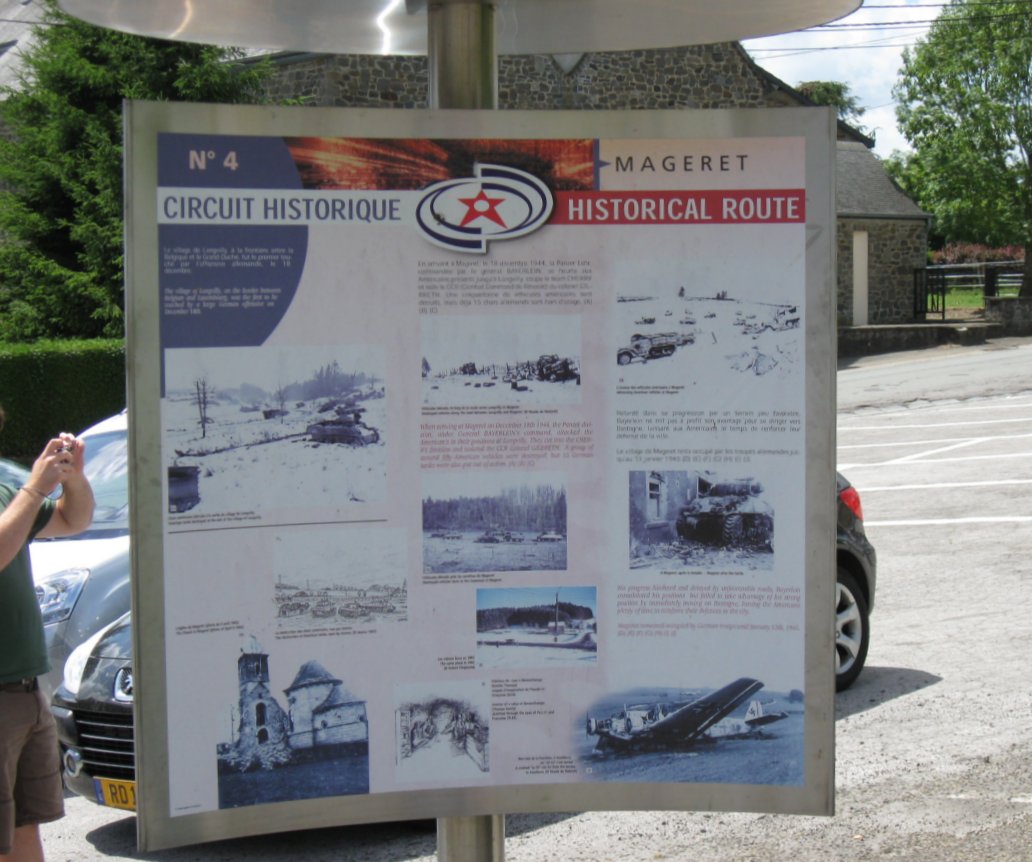
The Mageret kiosk includes a photograph of a knocked-out 6th Armd. Div. tank that I recognized from Hofmann's "Super Sixth".
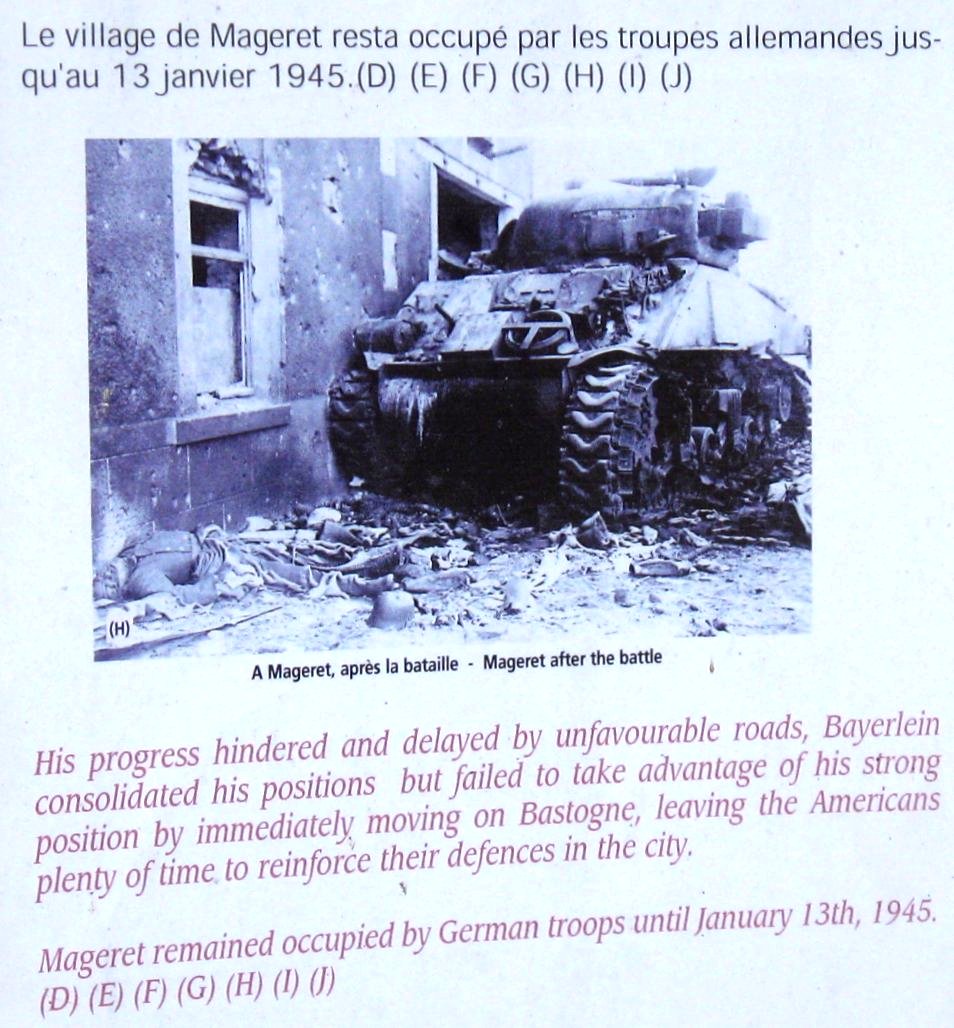
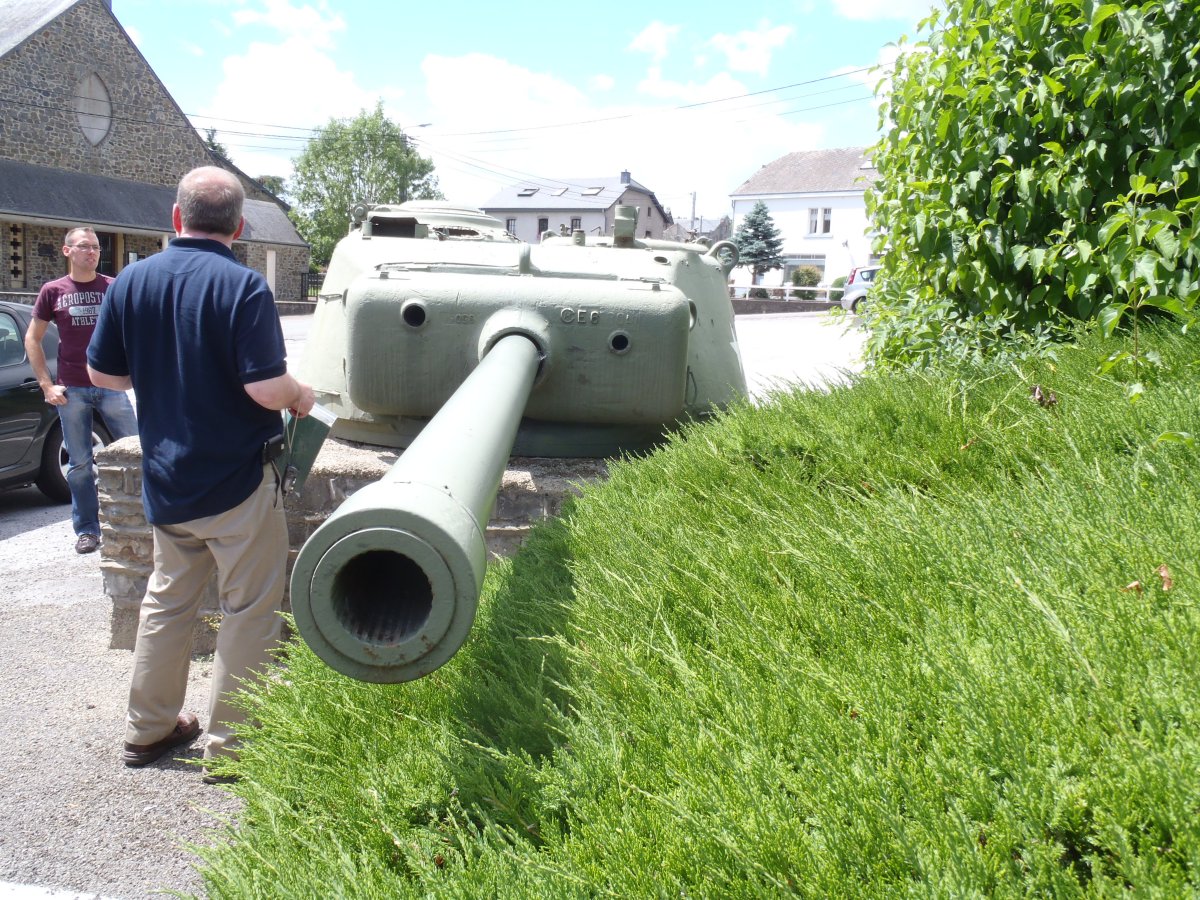
We did a quick look around to see if we could recognize the building where the photograph was taken, but did not see any likely candidates. Incidentally, this site is typical of many Belgium sites: tank turrets are mounted at town borders and at historical sites throughout the country.
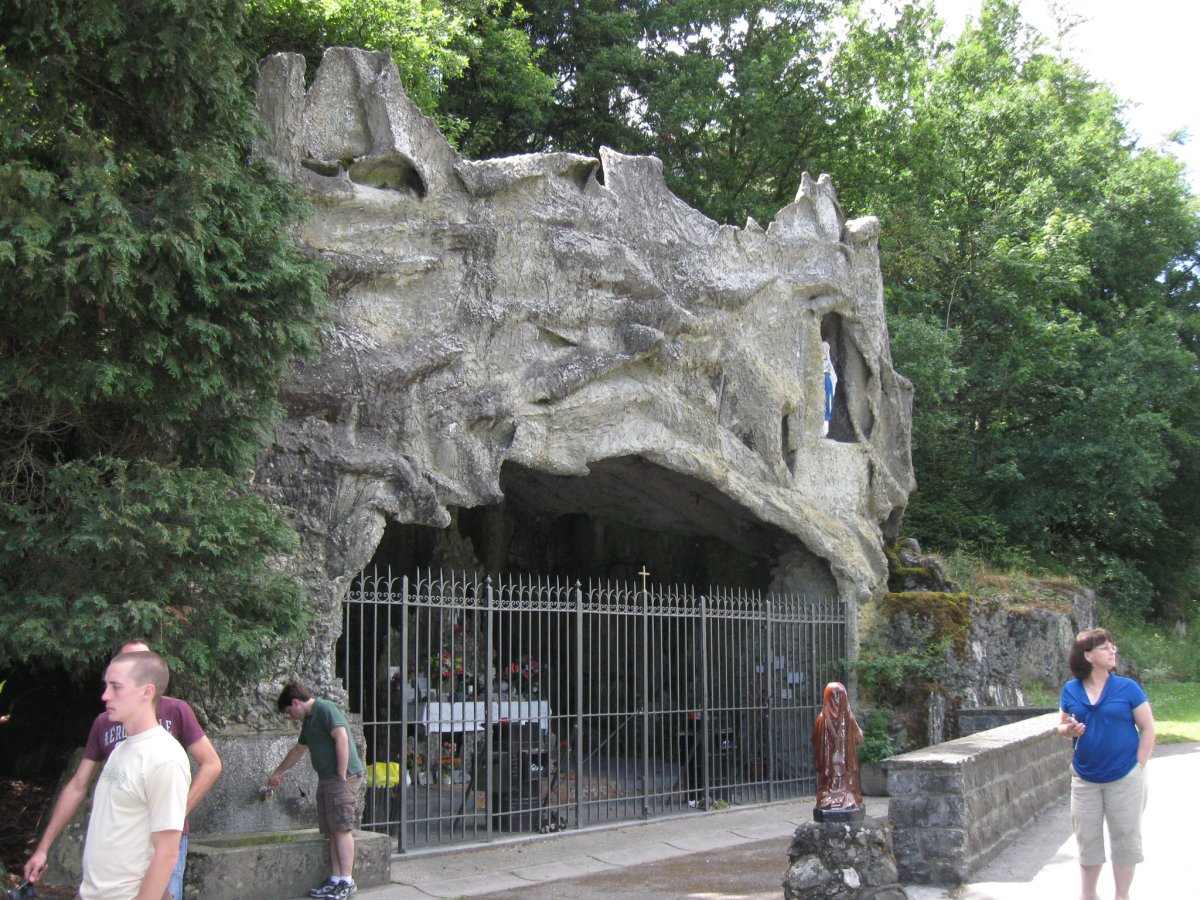
We continued our journey toward Luxembourg, stopping every few kilometers so Daniel could point out a site of significance. Since I tend to focus on the 6th Armored Division, my meager knowledge about the Battle of the Bulge tends to focus on the events after December 31, 1944, when the 6th started driving the Germans back to the Fatherland. My knowledge of the initial offensive, and the heroic stands made by small, scattered American units is lamentably lacking. But Daniel's knowledge of this period is encyclopedic, and I learned things about other units that I never knew. For example, I always associate the 9th Armored Division with the bridge at Remagen, but I never realized how badly mauled they got during the opening days of the Battle of the Bulge. One stop we made was at a road-side religious shrine, the grotto of St. Michael near Longvilly. This spot took on special significance after the Battle of the Bulge due to the horrific fighting that took place there, where the 10th Armored Division's Team Cherry made a heroic but doomed effort to stop the German on-slaught.
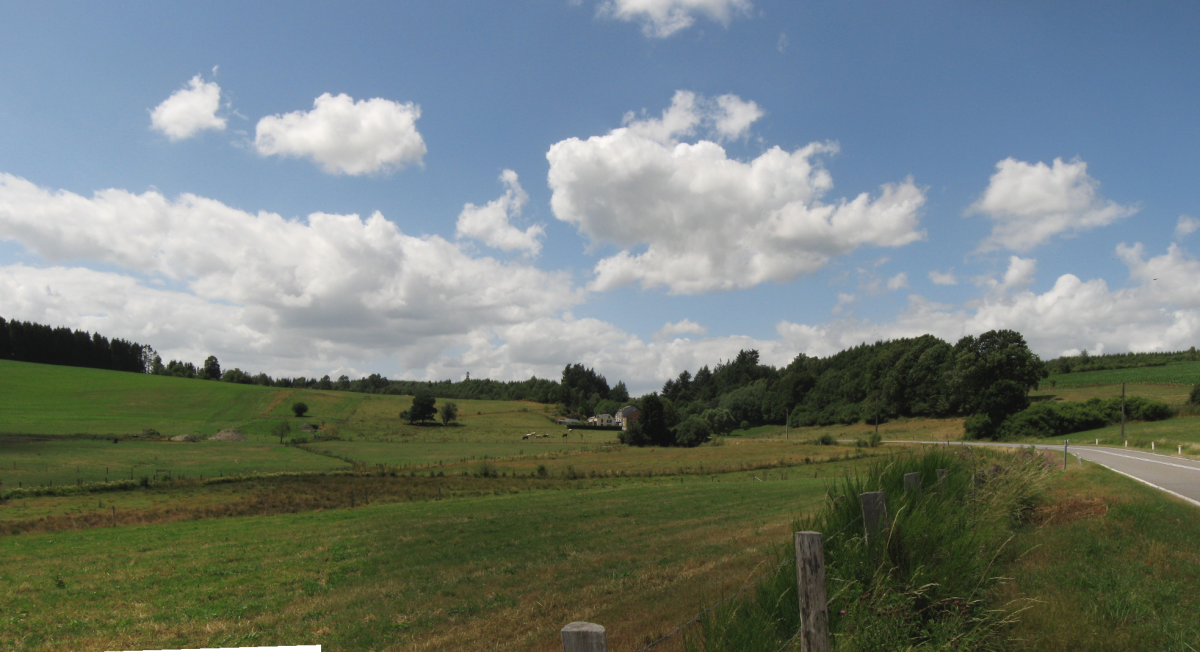
A kilometer down the road, we stopped again to view the fields across which the Germans advanced on December 18, and then retreated under fire of the 6th Armored Division a month later, on January 15. Again, it was difficult to imagine these beautiful, peaceful farmlands as seen in summer, covered in ice and snow, with armored vehicles racing across them.
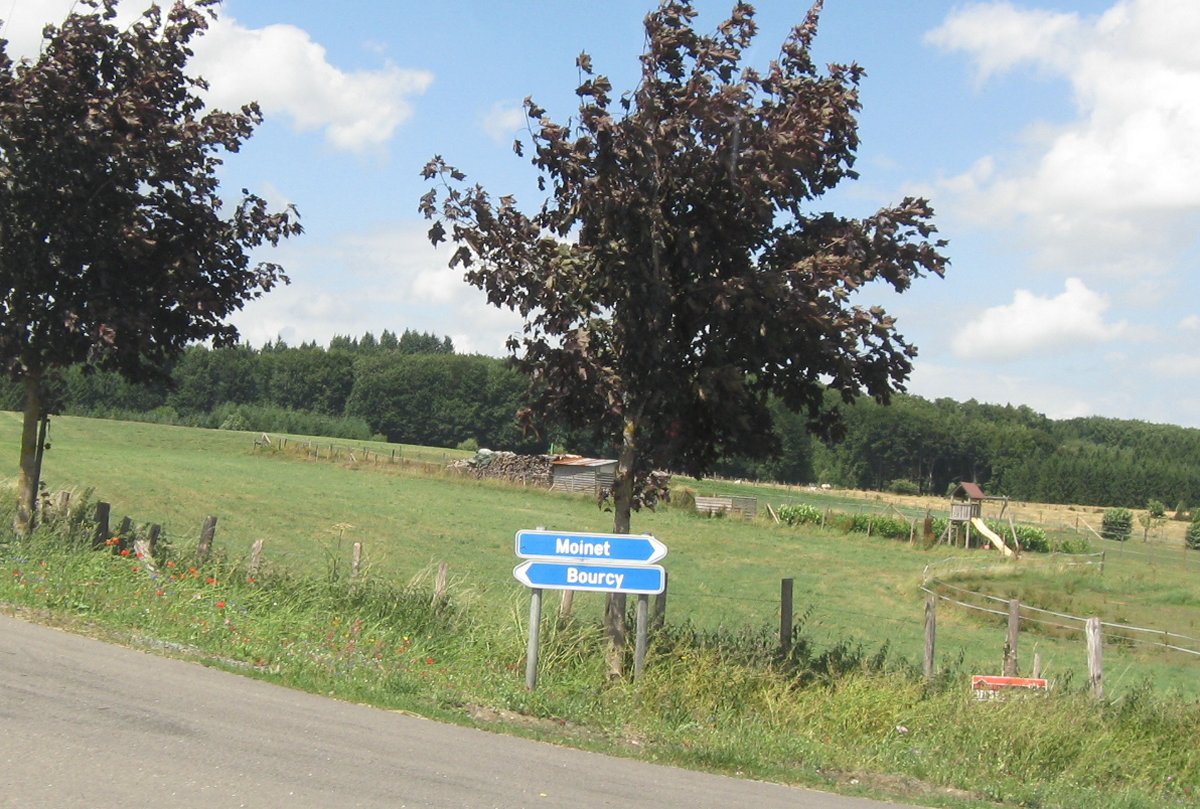
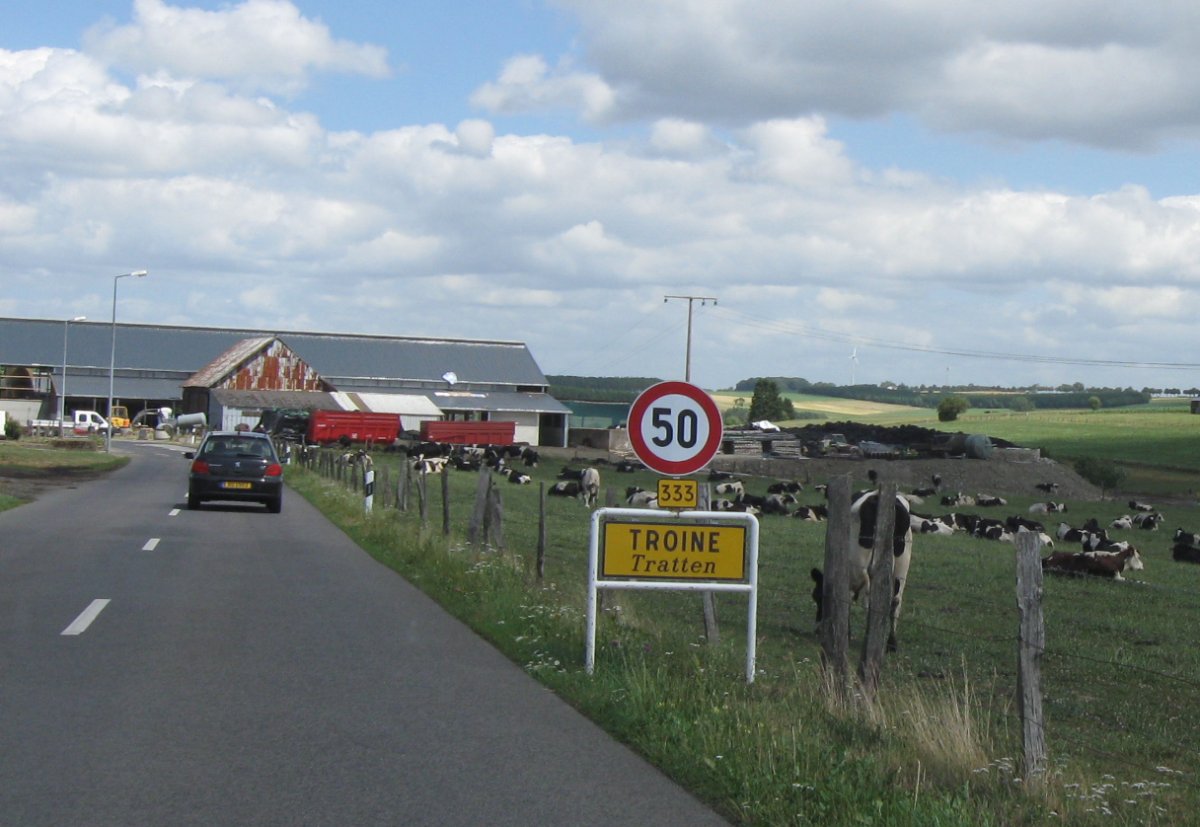
From Longvilly, we proceeded to Moinet, Troine, and Hachiville. It was hard to imagine armored columns of tanks, half-tracks, M7s, and M10s maneuvering down these roads 65 years ago .
At one point (Hachiville, I believe), Daniel pulled out a detailed WW II map showing the location of individual units and gun emplacements. It would take a week or more to explore all the locations that we could have stopped at.
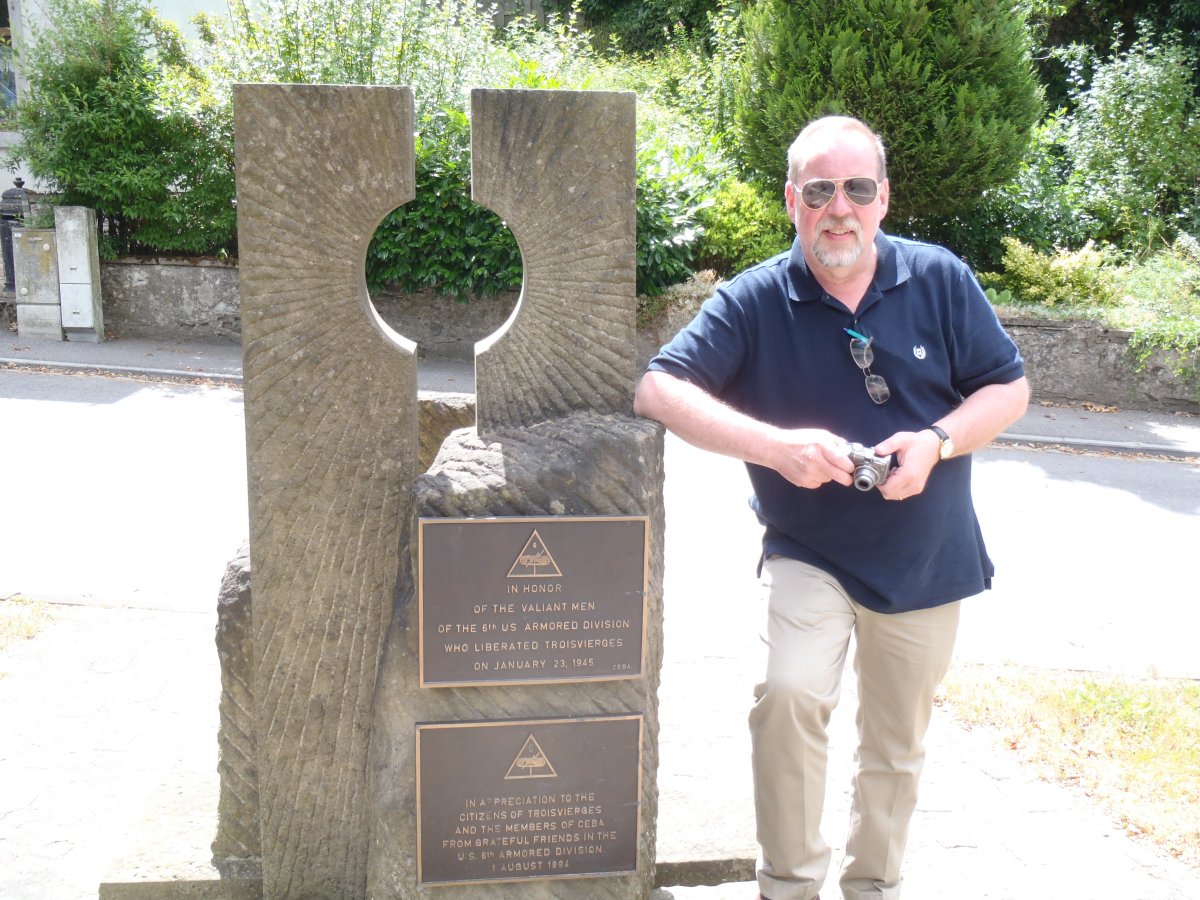
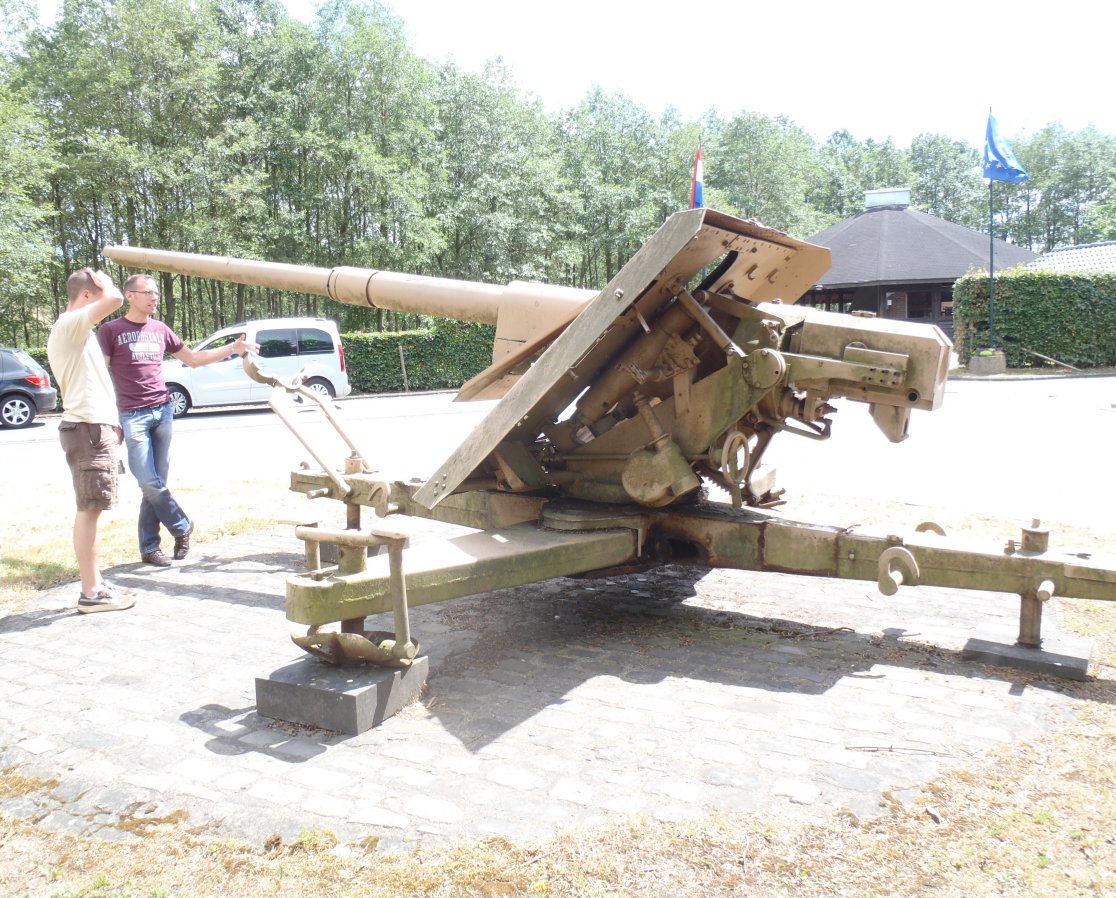
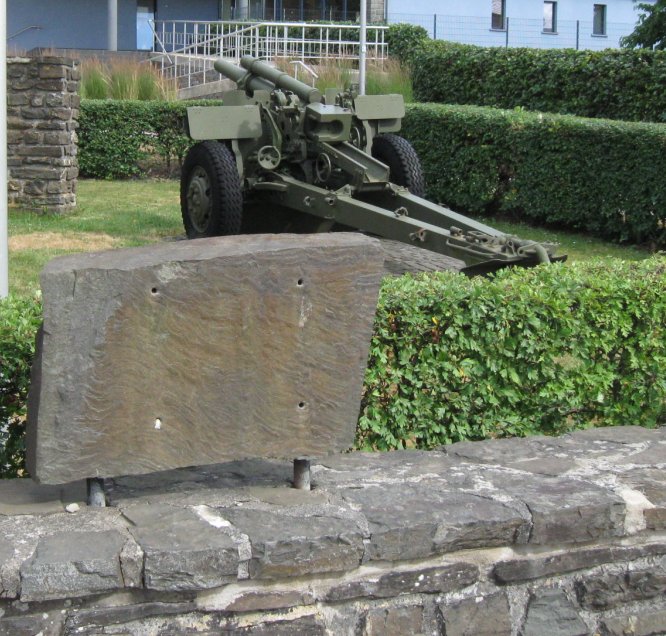
Like many memorial sites, this one includes a piece of artillery. In the picture below, Daniel explains to my son Robbie how to take out a tank.
From Trois Vierges, it was off to the area of Weiswampach, the site of fierce fighting as the Germans made one of their last stands before being pushed back across the Our River. We stopped to check out the area where the 35th Infantry Division's 134th Infantry Regiment, attached to the 6th, cleared the woods from Wilwerdange to Binsfeld. Daniel then guided us to a wooded area where he had discovered the still-visible remains of German foxholes that had faced the advance of the Super Sixth. "Foxhole" is really a misnomer, as these had been large, deep entrenchments, covered with tree trunks, capable of holding four to eight soldiers.
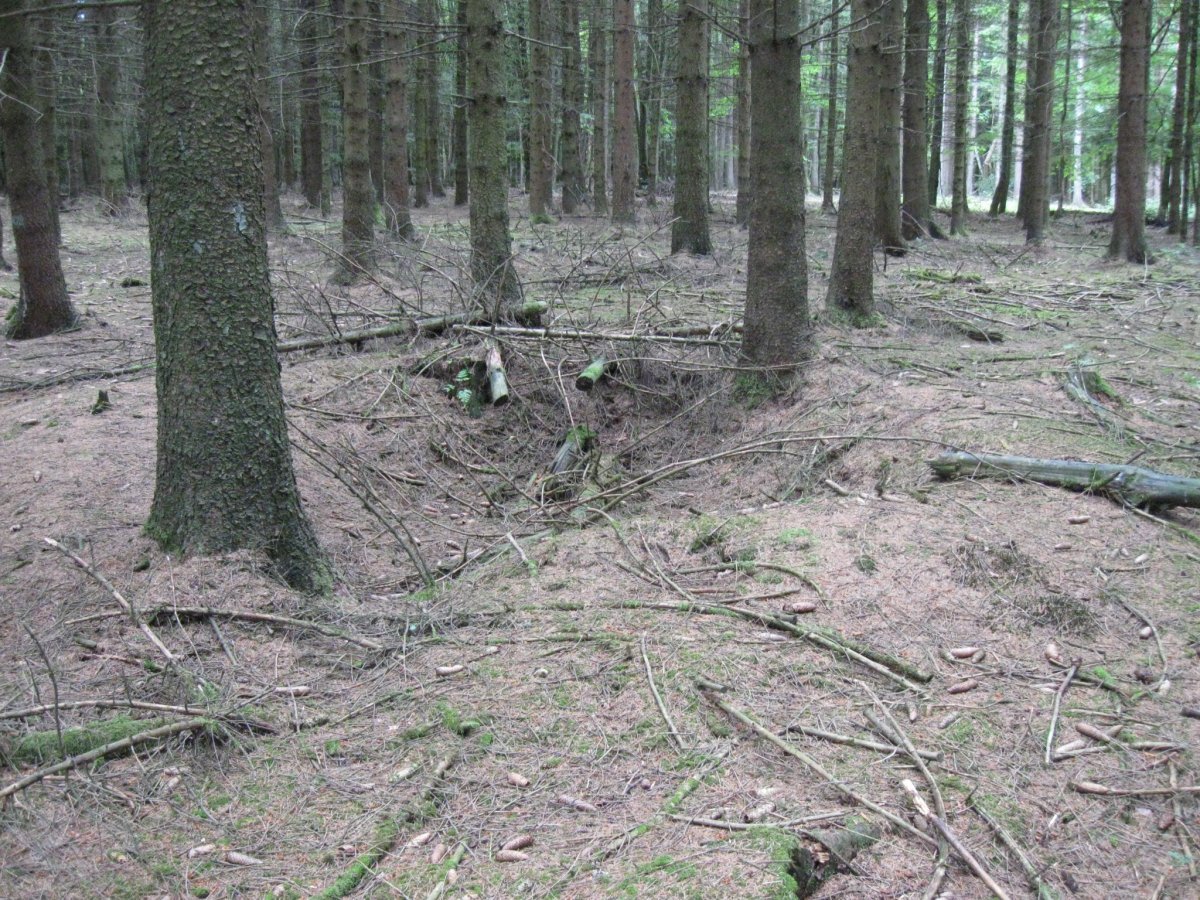
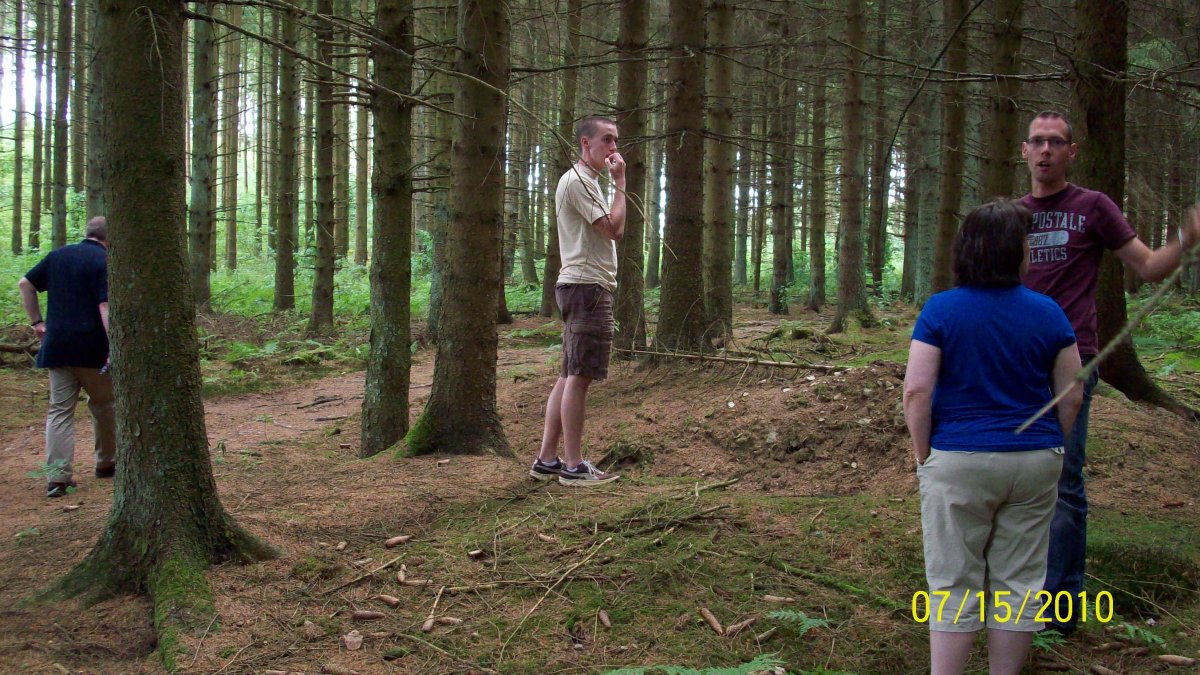
While we explored the entrenchments (there were about a dozen of them, roughly 30 meters apart), Daniel explained how there were no laws to preserve sites like this. He also said that some unscrupulous, profit-only collectors have given history buffs and conscientious collectors a bad name, by trespassing, digging relics up without permission of the land owner, and leaving a mess when they leave.
In the center of Weiswampach, we visited the impressive memorial to Co C, 134th Infantry, 35th Infantry Division, who fought side-by-side with 6th Armored Division units.
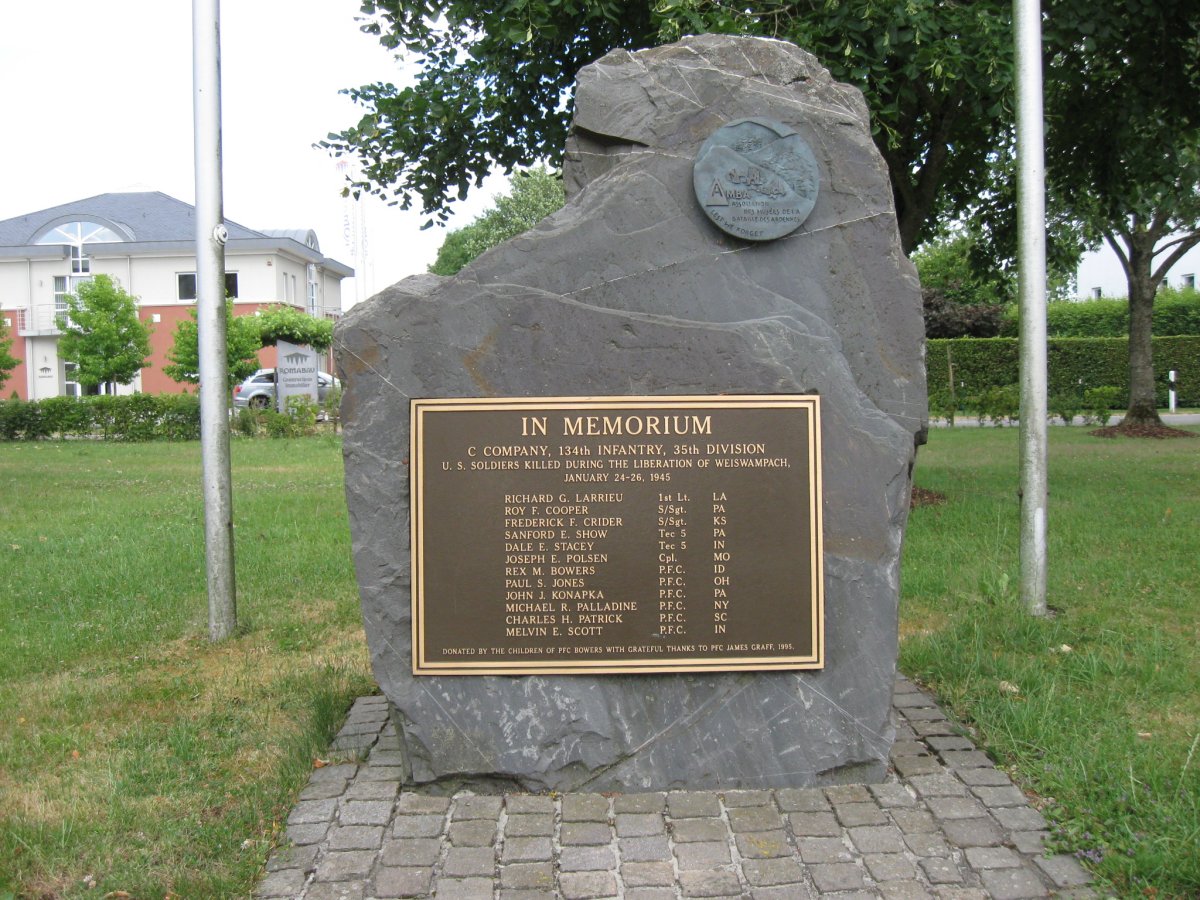
Then we went up the road a short distance where Daniel had identified the exact location where the 6th Armored Division intersected the Skyline Drive and started to move south. The sketch from the Combat Record covering this phase of fighting can be viewed at https://www.super6th.org/record/ardennes_sketch_17.png
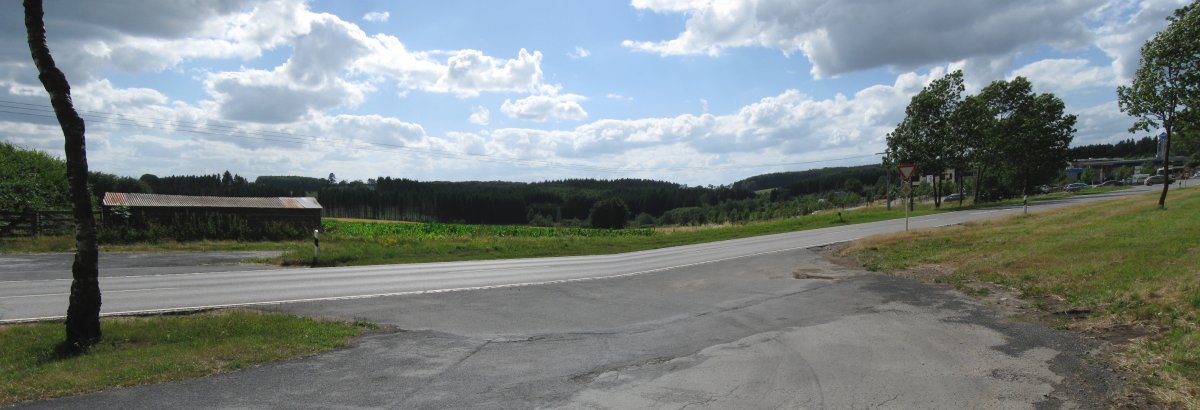
The photo is taken from across the Skyline Drive (on the eastern side). Elements of the Division would have been approaching from the west, across the field and up the road toward the present day gas station that you can see to the right of the photo.
From here it was a short drive to Heinerscheid, the site of the largest Sixer memorial.
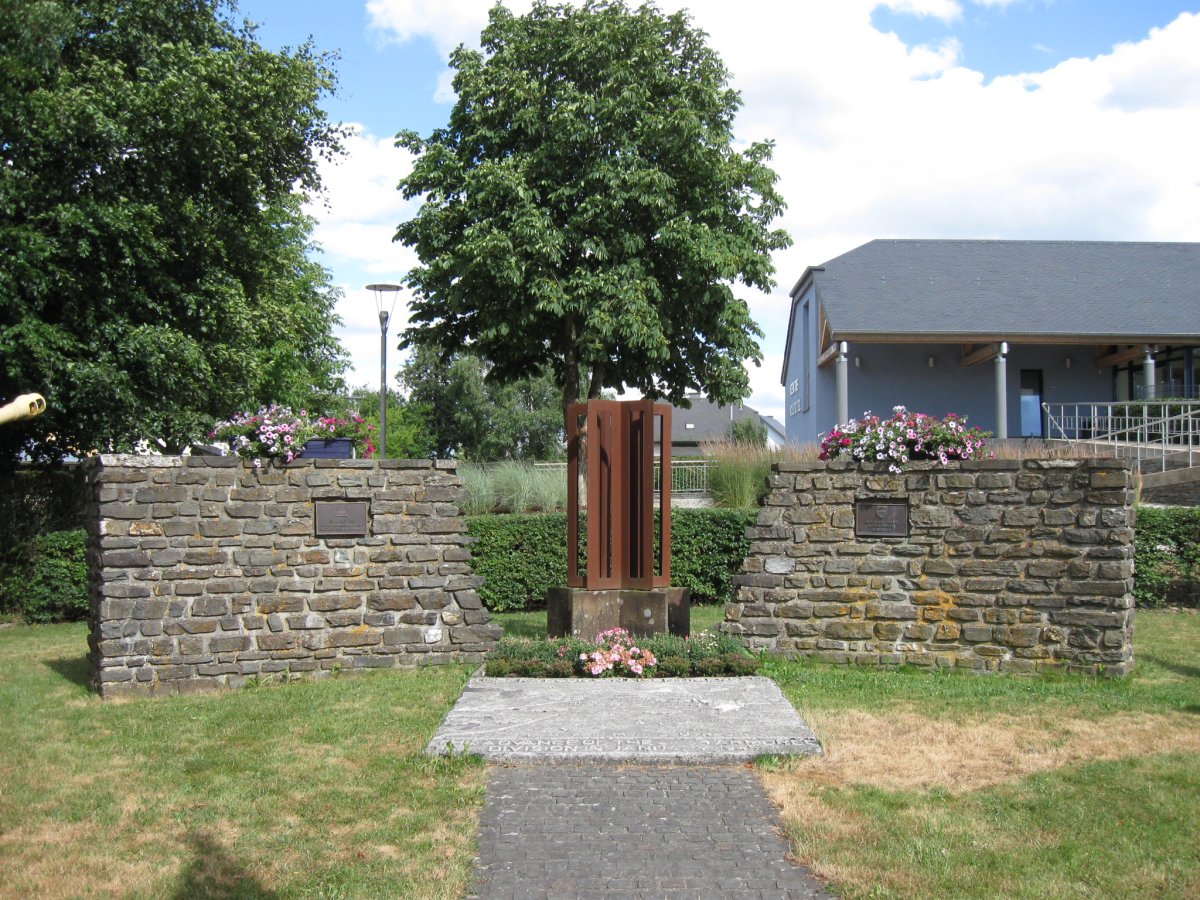
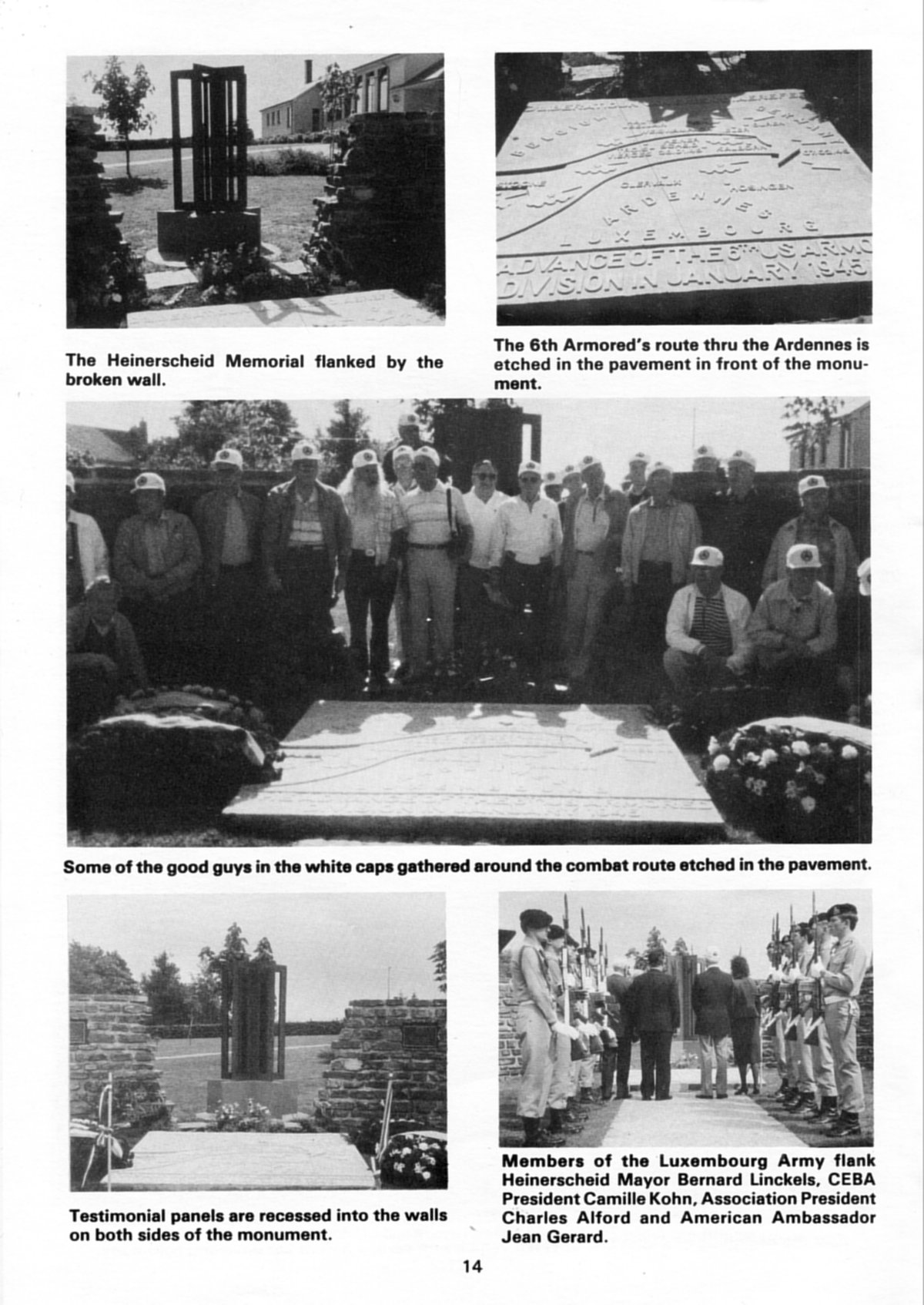
Unfortunately, time has not been kind to this memorial, and the large concrete map showing the Super Sixth's route is now almost unreadable:
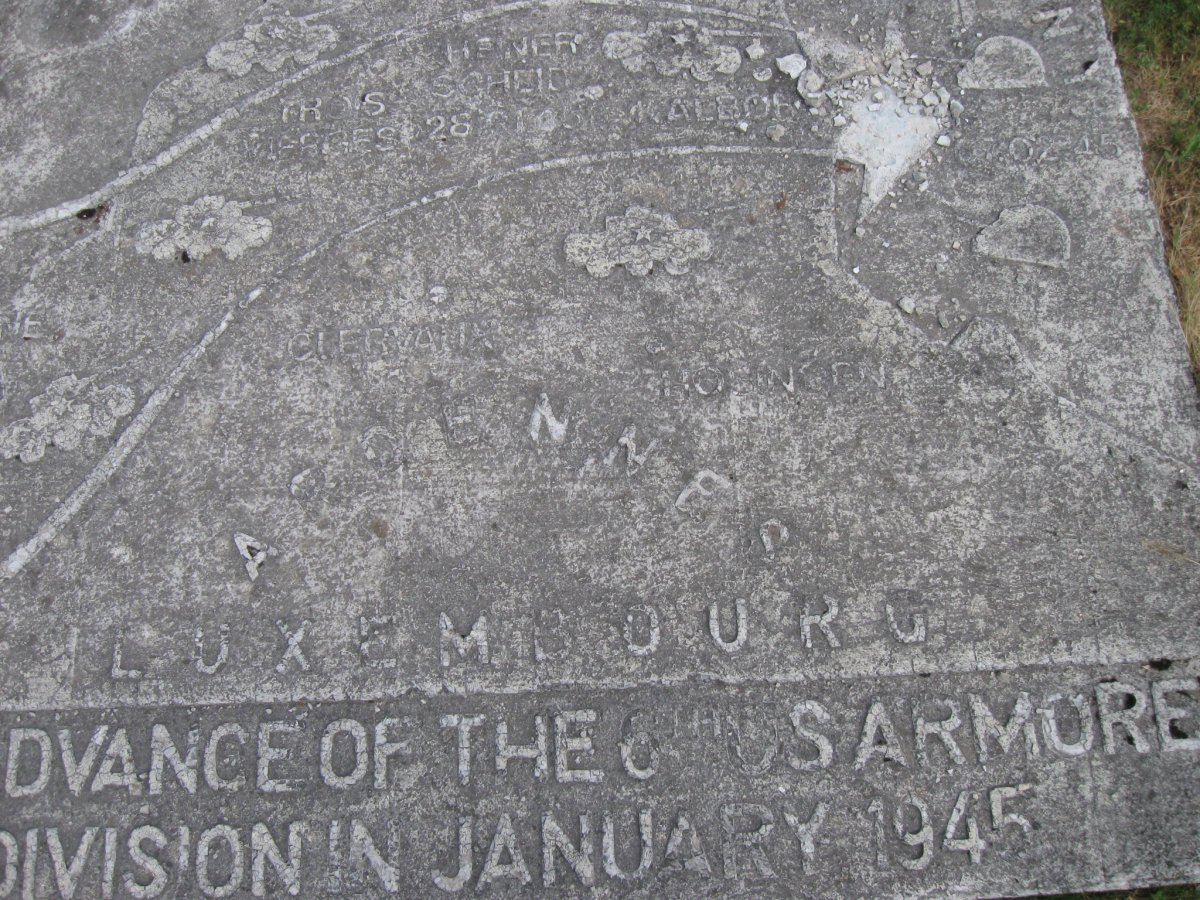
A plaque at the entrance is completely missing.
It is far different than the site proudly featured on this page from the August 1986 edition of the Super Sixer newletter.
Headquarters Company, 128th Armored Ordnance Maintenance Bn. alone buried two hundred animals and evacuated 20 German bodies, The psychological effect was intense and to relieve the pressure, the ordnance personnel from Headquarters Company towed a disabled German tank to an isolated spot and every bazooka, rifle, and machine gun in the company opened up sending a withering streak of fire-power into the tank.
But the break didn't last long -- In the first week of February, units including the 25th Armd. Combat Engineers, as well as the 9th and 44th AIB were given the task of crossing the Our River which paralleled the Skyline Drive and which separated Germany from Luxembourg. There were few places to do this: above and below the destroyed bridge on the Kahlborn-Dahnen Road, at the destroyed bridge further south at Dasburg, and still further south at Eisenbach. One of my main goals of the trip was to see the spot where the famed sign declared "YOU ARE NOW ENTERING GERMANY COURTESY OF THE US 6TH ARMORED DIVISION". Based on Hofmann's "Super Sixth" and on Hudson Wirth's description of his visit in the 1990s, I believed that this sign, which had been mounted on a pillbox, was right at the site of the Dasburg crossing. However, Daniel was certain that no pillboxes existed this close to the Our River. He speculated that the site I wanted was actually a few miles in-land, and since I knew from experience that stories were often inaccurate, I assumed that he was correct and that we might well never locate the site of the sign.
In any case, Daniel took us first across the bridge on the road out of Kalborn. This was where Horace Lennon, 25th Armd. Combat Engineer and husband of long-time Sixer e-mail list member Pat Lennon had been tossed into the freezing water of the Our River during a crossing attempt. And it provided me with my next opportunity for a "then & now" photograph.
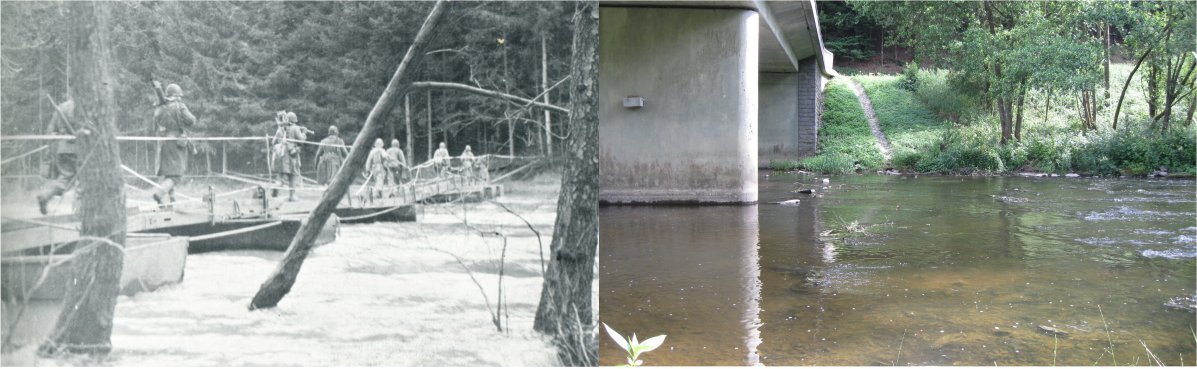
The 1945 pontoon bridge shown was constructed within a few hundred meters of today's bridge, although we don't know the precise location. As can be seen in the 2010 photo, the Our River is typically not very deep nor very wide. But when the 25th Engineers first tackled it in 1945 it was in flood stage, and men were tossed out of the boats which they initially used to cross, and some were drowned. From Hofmann's "Super Sixth": "The thaw which began to set in on the first of February caused the river to rise to 10 feet, to be 100 to 150 yards wide and flowing at 10 to 15 miles per hour." As Division C.O. Major General Grow commented "A river crossing is one thing; a night river crossing is another; a night crossing of a flooded river in freezing weather is someting else again; but when you follow that with an assault up the slopes of a mountain, into the guns of the Siegfried Line -- brother, then you've really got Ham and Eggs!"
For more details, see the "Combat History of the 6th Armored Division" at https://www.super6th.org/cmbthist/cmbtdasb.htm.
After this stop, we returned to our cars and drove down along the German side of the Our River to Dasburg, site of the second major crossing. I didn't realize it until I returned home and re-read the Division histories, but we were doing exactly what the 6th Armored Division had done. I had always assumed that they crossed the Our at Dasburg from Luxembourg into Germany, from west to east. But because of the defenses at Dasburg, the Sixth crossed at the Kalborn road bridge site, drove south through Germany, and hit Dasburg from the rear. THEN they built another bridge there across the Our.
As we neared the Dasburg bridge, I half-heartedly looked for places where the famous ENTERING sign might have stood. But as we came around a curve and approached the bridge, there it was to our right! An old pillbox, covered with trees and bushes, and closed off with concrete, but with the correct flat surface at the correct orientation. Defintely the site of the famous sign!
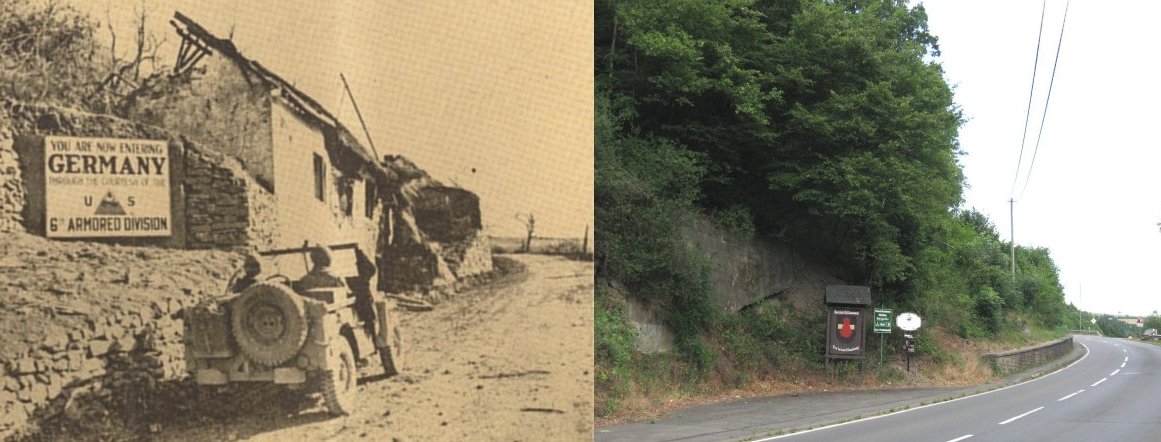
We pulled our cars over, and Daniel was saying "I've passed by this spot a hundred times and never realized that there was a pillbox here!" It was great to actually find the spot, and a great way to end our tour. By the way, the little signs at the same location today say "Cordial Welcome! Dasburg Resort" and "Beer garden".
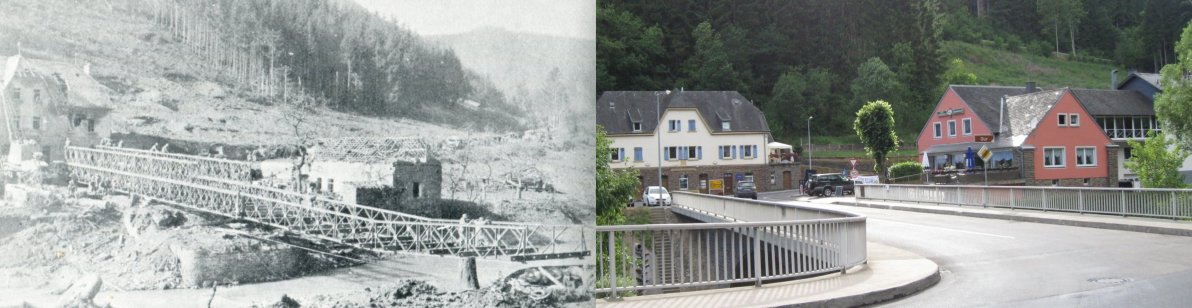
But the surprises were not yet over. On page 322 of Hofmann's Super Sixth is another photograph of the Dasburg bridge area. I didn't see anything that resembled it, and almost missed a great opportunity. I guess for some reason that I have always made the mistaken assumption that Super Sixth photographs were taken facing the line of march, and it never occured to me to turn around. Daniel said, "Look at that building across the river! It's the same one in the photo!" Sure enough, if you turned with your back to the location of the "Entering" sign and looked across the bridge back into Luxembourg, there was the building shown in the photograph. Another WW II photograph location identified!
Now the WW 2 history part of our visit was truly over. It was dinner time, at the end of a long day, and we were ready to find a good place to relax. We passed on the first couple of restaurants we checked out, and decided to head back to Clervaux. There Daniel ran into somebody he knew from the police force, and he recommended the restaurant and cafe at one of the other Clervaux hotels, situated on high ground with a nice view of the town, and outside tables. Perfect!

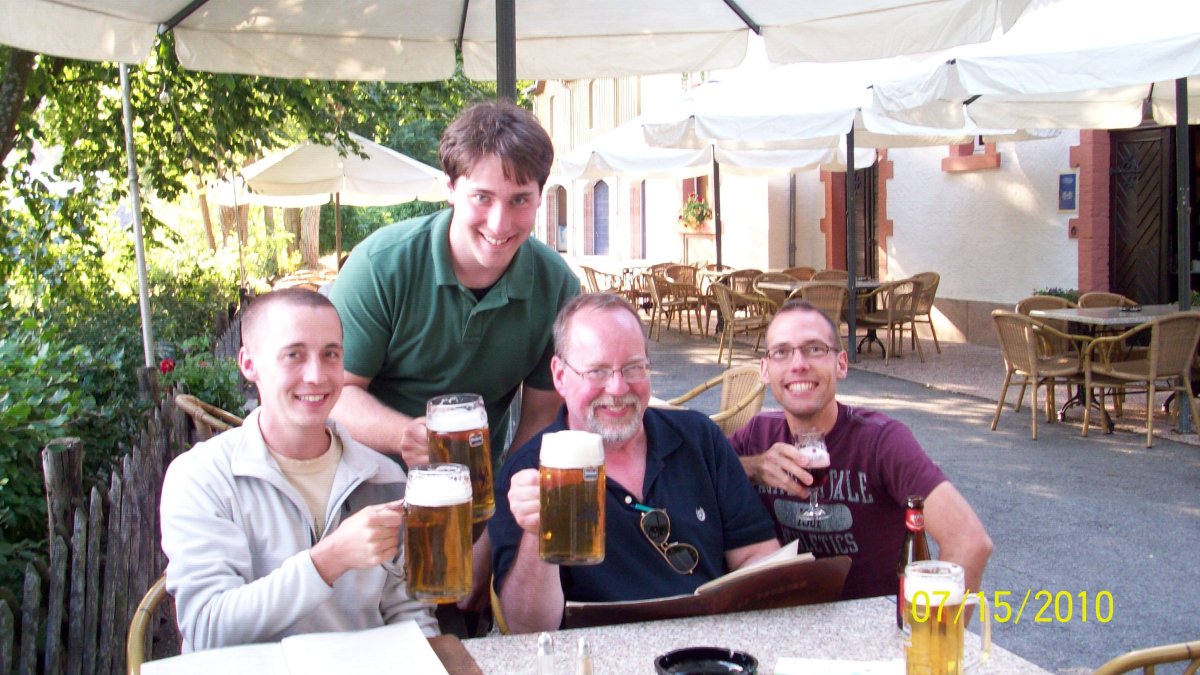
The service was friendly, and the food was good, and best of all, they served Diekirch in enormous mugs. It was truly a fitting end to a wonderful two day journey. Joan snapped the final photo, which I think sums up my family's feeling: we were fortunate to gain such a good friend as Daniel Reiland, and we have a great appreciation for the US Veterans Friends, Luxembourg. We are deeply indebted to Daniel and the USVFL for making our visit to Luxembourg one of the high points of our lives. Thank you, Daniel, and thank you, Luxembourg.
Bruce Frederick
August 20, 2010